
Piano Trip - Magic Music Game
Puzzle Games Star StudioMusic
4.6203.00 Reviews
- Version
- 1.5.8
- Installs
- 10.00M
- Age Rating
- Everyone
Screenshots







Our Review of Piano Trip - Magic Music Game
 Analysis by Appyee
I approached Piano Trip - Magic Music Game as a quick music game rather than a piano-learning tool, and that distinction matters from the first tap. Its appeal is immediate: choose a track, watch the play area, and try to keep your fingers aligned with the rhythm. I found it easy to understand without a tutorial-heavy introduction, which makes it suitable for short breaks, casual play, and anyone who enjoys testing hand-eye coordination through music.
The game is free, carries an Everyone content rating, and comes from Puzzle Games Star Studio. It belongs to the music-game category, not to the same group as serious digital keyboards or structured lesson apps. If I wanted to practice scales, read sheet music, or build a disciplined piano routine, I would look elsewhere. If I wanted a light game that turns familiar piano-style interaction into a repeatable challenge, this is where Piano Trip makes sense.
How I Decide Whether Piano Trip Fits
My first decision criterion is the kind of attention a game demands. Piano Trip works best when I can give it a few uninterrupted minutes and focus on timing. It is not especially useful when I am looking for background entertainment that I can play with half my attention. Missing beats is part of the challenge, so interruptions, noisy surroundings, or constant switching between apps can make the experience feel more frustrating than fun.
The second criterion is expectation. The store summary presents the game as a rhythm-focused piano experience, and that is the right way to approach it. The word “piano” describes the theme and interaction, not a replacement for an instrument. I would recommend it to someone who likes rhythm games and wants a piano-flavored setting. I would not recommend it to a beginner who expects guided lessons, fingering explanations, or feedback about musical technique.
I also consider how quickly a game earns a place on my phone. Piano Trip has a low barrier to entry because it is free and supports devices running Android 6.0 or later. That makes it approachable for people using older compatible phones, although the exact feel will still depend on the device’s touch response and screen size. On a smaller display, accurate tapping can feel less comfortable, especially during faster passages.
Its audience size suggests that the basic idea has broad appeal: the game has passed 10 million installs and holds a 4.6 average from roughly 15 thousand ratings. I treat those figures as a sign that the central loop is accessible, not as proof that it will suit every player. Rhythm games are personal. Some players enjoy repeating a section until their timing improves; others quickly tire of retrying the same pattern.
Another useful criterion is whether I want a game for solitary concentration or social competition. Piano Trip is most naturally suited to individual play. If my main motivation is comparing detailed scores with friends, joining a community, or following a competitive ranking system, a more explicitly social rhythm game may be a better match. Here, the pleasure comes from the immediate relationship between the music, the screen, and my own timing.
The First Few Sessions
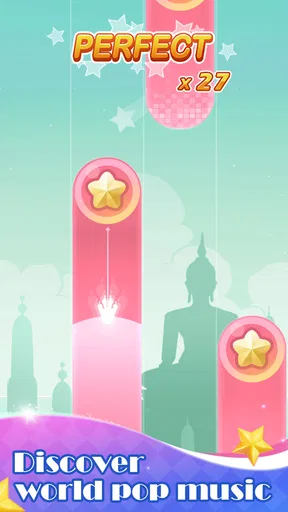
My first sessions with this kind of game are always about learning its visual language. I watch how the notes or tap targets approach, then adjust my finger placement and tempo. The important shift is to stop reacting to every individual note as a surprise. Once I begin anticipating the next pattern, the game feels less like random tapping and more like following a musical phrase.
That makes Piano Trip more enjoyable after a short adjustment period. A new player may initially tap too early because the visual movement creates a sense of urgency. I found that keeping my eyes slightly ahead of the target area helped. I also preferred using one consistent finger position instead of moving my hand around the screen. This is a small habit, but it reduces unnecessary movement and makes repeated attempts feel more controlled.
Headphones can also change the experience, particularly when the surrounding environment is busy. The rhythm is easier to follow when the music is clear, but I would still keep the volume comfortable and avoid treating the game as a substitute for a metronome. The purpose is entertainment and timing practice inside the game, not precise musical training.
Where the Game Wins
The strongest part of Piano Trip is its immediacy. I do not need to understand music theory before playing, and I do not need to commit to a long session. That gives it a useful role in everyday routines. I can play while waiting for an appointment, during a short commute when it is safe and practical, or after finishing a task when I want a focused break rather than an endless scrolling session.
It also has a satisfying learning curve at the level of coordination. I can notice when I am improving because patterns that once felt rushed become more manageable. This is not the same as learning to perform a song on a real piano, but it does reward patience, visual tracking, and consistent timing. For players who enjoy small personal improvements, that loop can be more compelling than a game that gives everything away immediately.
A useful, less obvious advantage is that the game can act as a quick concentration reset. When I play deliberately, I stop dividing my attention between notifications and other tasks. A short attempt gives me a clear objective: follow the beat and avoid mistakes. That makes it a better break for me than passive video watching when I want to wake up mentally without starting a large game.
It is also a reasonable choice for families looking for an accessible music-themed game. The Everyone rating makes the age positioning straightforward, and the basic interaction is easy to demonstrate. Still, I would supervise younger players in the same way I would with any mobile game, especially around screen time. An age rating describes content suitability; it does not decide how long a child should play.
The game’s version is 1.5.8, and I see that as useful context when deciding whether to install it on a compatible device. I would keep the app updated through the relevant platform rather than relying on an old installation, because rhythm games benefit from a stable touch response and a current build. I would also test the first session with the phone held securely; a loose grip can lead to accidental taps and make the controls seem less accurate than they are.
Small Techniques That Improve the Experience
My first practical tip is to separate learning attempts from score attempts. On the first run through a difficult section, I focus on recognizing the pattern and keeping a steady rhythm. On the next run, I try to reduce mistakes. Chasing a perfect result immediately often makes me tense, which causes early taps and breaks the rhythm. Treating the first attempt as reconnaissance gives me more useful information.
My second tip is to choose a comfortable posture. I get better results when the phone is supported rather than held awkwardly in one hand. This matters because repeated tapping can make the wrist stiff, and stiffness affects timing. A stable position also helps me keep my eyes at a consistent angle, which makes moving targets easier to judge.
My third tip is to use the game in short blocks rather than forcing a long session. Once my reactions become tired, I start tapping based on panic instead of listening and watching. A brief pause can restore accuracy. This is especially important for younger players or anyone using the game as a break between work tasks, because the point is to refresh attention rather than turn the break into another demanding obligation.
I would also avoid judging the entire game from one difficult song or sequence. Rhythm games can feel unfair when I have not yet learned the visual timing, but repeated play often reveals whether the problem is the pattern or my approach. If I still dislike the interaction after several calm attempts, that is valuable information: the game may simply not match my preferred rhythm-game style.
Where Other Choices May Fit Better
The usual alternatives fall into several different categories, and Piano Trip should be compared with each on its own terms. A real keyboard or a virtual piano app is better when I want to explore notes freely, practice chords, or understand how melodies are built. Those options offer musical control that a tap-based rhythm game does not. They can also feel slower and less game-like, so they are not automatically better for casual entertainment.
Structured piano-learning apps are another category. They are the stronger choice for someone who wants lessons, exercises, reading practice, or a planned path from beginner to more capable player. Piano Trip may help with general timing and finger attention, but I would not use it as my only learning method. A player who installs it expecting progress to transfer directly to piano technique could be disappointed.
Traditional rhythm games may suit players who care more about complex input styles, deep progression, or a particular music library. Piano Trip’s piano presentation is appealing if that theme is what attracts me, but it may not satisfy someone searching for a large competitive ecosystem or a highly specialized challenge. Since rival games vary widely, I would choose by the interaction I want rather than by assuming every music game offers the same experience.
There is also a simple alternative: listening to music without playing anything. That is better when I want to relax completely. Piano Trip asks me to participate, monitor timing, and accept mistakes. Its value comes from active attention, so it is not the right answer for every mood. If I am tired and only want something calming, a music player will be more suitable.
The clearest reason to skip Piano Trip is a dislike of repetition. Improving at rhythm games usually means replaying sections, and the satisfaction depends on accepting that cycle. Players who prefer exploration, story, strategy, or open-ended creativity may find the tap-and-retry structure narrow. I would also steer away from it if accurate touchscreen timing is important but my phone has a small or unreliable display.
What Switching Involves
Moving from a conventional piano app to Piano Trip requires changing the goal. I would stop expecting free experimentation and start looking for timing challenges. That switch is easy if I want a game, but it can feel limiting if I have already built a routine around practicing melodies. Conversely, moving from Piano Trip to a lesson app means accepting a slower, more deliberate process with more explanation and less instant action.
The cost of switching is mostly time and habit rather than money, since Piano Trip is free. I can try it without making a financial commitment, then decide whether its rhythm loop deserves regular attention. The more important question is whether I want to relearn how to measure progress. In this game, progress feels like cleaner timing and better control; in a learning app, it may be a completed lesson or a new musical skill.
For an everyday example, imagine having ten minutes before leaving home. Piano Trip can fill that gap with a focused attempt, but it may also leave me wanting one more try if I miss near the end. If I need to leave immediately, a calmer app would be easier to stop. During a longer evening break, however, the retry loop becomes more comfortable because I have time to settle into the rhythm.
Families should also think about device sharing. A game that feels simple to one person may be challenging to another because finger reach, reaction speed, and familiarity with rhythm games differ. I would let each player try a short session before deciding whether it is suitable. That avoids assuming that the Everyone rating means every age group will find the same level of enjoyment.
My Recommendation
I recommend Piano Trip to Android users who want a free, music-themed rhythm game that is easy to start and rewarding in short focused sessions. It is particularly well suited to players who enjoy improving through repetition, like piano-style visuals, and want an active alternative to passive phone use. The large install base and strong average rating reinforce that it has found an audience, while the current version gives compatible users a clear starting point.
I would not present it as a piano teacher, a replacement for a keyboard, or the best option for competitive rhythm-game specialists. Those needs point toward different categories of apps. I would also skip it if I strongly dislike retrying patterns or if my phone’s touch experience makes precise tapping uncomfortable.
After weighing those trade-offs, my view is positive but specific: Piano Trip is best when I treat it as a compact rhythm challenge, not as musical education. That expectation makes its strengths clearer. It offers a simple way to focus, test timing, and enjoy piano-flavored gameplay without paying to begin. For a friend asking whether to download it, I would say yes—provided they want a game built around listening, watching, and trying again rather than a full piano-learning experience.
Verdict
Strengths of Piano Trip - Magic Music Game
- Simple tap-based controls are easy for beginners to learn.
- Short songs make it convenient for quick gaming sessions.
- Bright visuals and rhythmic effects make gameplay feel lively.
- Increasing speed provides a satisfying challenge as skills improve.
- Works well as a casual game for music and rhythm fans.
Limitations of Piano Trip - Magic Music Game
- Some songs or features may require in-app purchases to unlock.
- Repeated patterns can make the gameplay feel repetitive over time.
- Fast sections may be difficult on smaller phone screens.
- Ads can interrupt the experience, especially in the free version.
- Performance may vary on older devices during busy visual effects.
Similar Picks in This Category
View All
Tiles Hop Music & Ball Game
AMANOTES PTE. LTD.4.3

Magic Tiles 3™ - Piano Game
AMANOTES PTE. LTD.4.6

Real Piano
Bilkon3.7

Piano Game: Classic Music Song
Dream Tiles Piano Game Studio4.0

Smash Colors: Music Ball Rush
BADSNOWBALL HONGKONG LIMITED4.2

Piano Music Go-EDM Piano Games
Joy Journey Music Games4.5
Frequently Asked Questions
What is Piano Trip - Magic Music Game?
Piano Trip - Magic Music Game is a rhythm-based mobile game in which you tap piano-style tiles in time with songs while traveling through colorful themed levels. The main challenge is to maintain accuracy and speed as the notes become more complex. It is designed for short, casual sessions, but the progressively harder stages can also appeal to players who enjoy improving their scores and reflexes.
How do you play Piano Trip - Magic Music Game?
Gameplay is based on tapping the correct tiles as they reach the target area, usually following the rhythm of the selected song. Missing a tile or tapping incorrectly can interrupt your combo or end the round, depending on the mode. New players should begin with easier tracks to learn the timing, then gradually move to faster songs and more demanding levels.
Is Piano Trip - Magic Music Game free to download and play?
The game can generally be downloaded without an upfront purchase, allowing users to try its core gameplay before spending money. However, free versions of rhythm games commonly include advertisements, optional purchases, or limitations on certain songs, lives, and progression features. Check the current store listing and in-app purchase details on your device before downloading.
Does Piano Trip - Magic Music Game require an internet connection?
An internet connection may be needed for the initial download, advertisements, updates, account-related functions, or access to additional content. Some previously loaded levels may work offline, but this can vary according to the version and device. If you plan to play while traveling, open the game beforehand and verify which songs and features remain available without mobile data or Wi-Fi.
Is Piano Trip - Magic Music Game suitable for children?
The simple tap-based controls and colorful presentation make Piano Trip - Magic Music Game approachable for many children and casual players. Nevertheless, parents should review the listed age rating, advertising practices, privacy permissions, and optional purchases before allowing unsupervised play. Fast levels may also become challenging, so younger players may benefit from starting with easier stages and limited play sessions.
Play our best games!


